Since the end of March is fast approaching, it's time for a quick review of the books I've read during the first quarter of 2010. Sorry, I'm not actually reading new books here - none of these have been published during the first three months of this year, they're just what I've been reading of late. Anyway, here goes (hover over a thumbnail for comments).

Tuesday, 30 March 2010
Monday, 22 March 2010
Music in adverts
I've written about the perils of using music in adverts before, but I can't help myself, I've got to do it again. Imagine my pleasure at hearing Isla de Encanta by Pixies wafting from my living room - brilliant! Then imagine me going into the living room and finding Black Francis et al are being used to soundtrack capitalist debt-mongers Visa and their sponsorship of the forthcoming World Cup. Yes, Visa! Why, oh why, aren't a band I believe in being used to sell us a product I can believe in?
But it's a double-edged sword, music use in adverts. If not for the Virgin Media advert I saw at the cinema a few weeks ago, chances are I would never had heard of Slow Moving Millie or her beautiful songs Beasts, which soundtracks the Virgin ad. Here it is for your viewing, and listening, pleasure.
Oh, and if you must, you can catch the Pixies/Visa ad here - just close your eyes when you play it, forget all about credit cards, and enjoy the music, okay?
Friday, 19 March 2010
Art, comedy, or a statement?
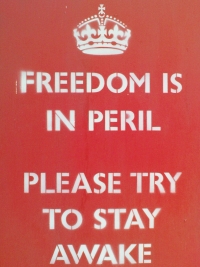
Something clever is happening on the streets of my adopted home town... to prove it, here are some snaps of graffiti I've found there recently. Is someone trying to be artistic, funny or subversive? Or all three? Whatever, if graffiti must exist, then it should all be like this.


Tuesday, 16 February 2010
Sometimes, I'm such a child...
In recognition of North Korean despot Kim-Jong Il's 69th birthday, I present... "Ronery"
You can buy Team America: World Police, from which this juvenile (but unashamedly funny) twaddle is taken, here.
You can buy Team America: World Police, from which this juvenile (but unashamedly funny) twaddle is taken, here.
Friday, 5 February 2010
No, they're not all the same...
An election is looming... how will you be voting? In the immortal words of Mike Reid, "Runaround... now!"
And yes, I am aware of the quirky order of the choices on display - the polling widget I'm using seems to randomly order the options, it's not a subliminal political preference being expressed, I promise.
Wednesday, 3 February 2010
Browser wars II - this time it's more... well, browsery
I did this once before and it proved mildly interesting so, if you can control yourselves, I'll do it again. These are the browsers that have brought the last 500 visitors to New Amusements.

So what's changed in the last nine months? Well, lots, actually, but let's keep this to browser usage. Internet Explorer is the big loser here, down 13% since May 2009. This translates neatly into small, and roughly equal, gains for Firefox, Chrome and Safari. Expected more of Opera though. Anyway, other points of interest from these figures are firstly the increasing diversity of browsing platforms that arrive at this site, and the growing use of mobile browsing devices. Interesting, though hardly unpredictable trends.
Also, though you can't tell it from this graph, nearly a third of the IE users that have been to this site recently are still using IE6 (it's nine years old people - what are you doing?). Given yesterday's news, isn't it time to move on?

So what's changed in the last nine months? Well, lots, actually, but let's keep this to browser usage. Internet Explorer is the big loser here, down 13% since May 2009. This translates neatly into small, and roughly equal, gains for Firefox, Chrome and Safari. Expected more of Opera though. Anyway, other points of interest from these figures are firstly the increasing diversity of browsing platforms that arrive at this site, and the growing use of mobile browsing devices. Interesting, though hardly unpredictable trends.
Also, though you can't tell it from this graph, nearly a third of the IE users that have been to this site recently are still using IE6 (it's nine years old people - what are you doing?). Given yesterday's news, isn't it time to move on?
Tuesday, 2 February 2010
Shaking hands with death
Much has been written lately about the legality, or otherwise, of assisted suicide. The flood of coverage is, in part, due to the trial of Kay Gilderdale, a woman accused of attempted murder because she helped her chronically ill daughter die. For once, common sense has prevailed, and after a protracted trial a jury took just two hours to throw the case out, and Kay can get on with trying to rebuild her life.
With this in mind, it seems entirely fitting that the BBC's annual Richard Dimbleby Lecture should be on the subject on how we, confronted with an increasingly older and often ailing population, need to redefine how we deal with death. The lecture was written by Sir Terry Pratchett, the author, but, because of the constraints a form of early-onset Alzheimer's places on him, it was delivered (with passion and style) by his friend, the actor Tony Robinson.
In case you think I'm a Pratchett fan, I'm not. I've never read anything of his - somehow it just doesn't appeal. But his thoughts on death, and how we deal with it - specifically, what might constitute a sensible approach to dealing with deaths that may warrant "assistance" - seem to me to be entirely realistic, pragmatic, and well thought out. Beyond that, I'm not going to try to convert anyone to my way of thinking - how we deal with death is at least as important as how we deal with life, as a great man once said, but whilst the law remains unclear then that choice will rightly remain a personal ideology.
Having said that... whatever your views on the subject, Pratchett's Richard Dimbleby lecture was 50 minutes of compelling and thought-provoking television. It's available to watch for the next seven days on the inestimable iPlayer, and I urge you to go and catch it whilst you can.
Wednesday, 27 January 2010
Up In The Air

My loathing of the crowd-pleasing but story-damaging ending can be traced back to watching Falling In Love in the early 90s. A decent enough romantic film, with two fine leads in DeNiro and Streep, it is nevertheless utterly ruined by an entirely unrealistic ending clearly designed to leave a sweet taste in the audience's collected mouth. It made me gag. Worse, it made me fume. Maybe where I was emotionally at the time didn't help, but there you go - whatever the reason, I fumed. Even now, about 20 years later, I can feel myself getting annoyed...
So hooray for Up In The Air, which doesn't make me gag or fume, mercifully. I heartily recommend you rushing to your local independent cinema to watch it. Or it will doubtless be available on Amazon before you know it.
Friday, 22 January 2010
Warning! I might rant...
So, as promised, a proper post; this is your chance to bail out early though, as it's going to be about something that made me cross, so I may rant.
Still here? Okay then. But don't say I didn't warn you.
Whilst driving down the A2 last Sunday, I was listening to news crumpet Kate Silverton's show on Radio 5 Live. Just for a while, you understand, and only once I had passed beyond XFM's broadcast range. Anyway, towards the end of her show, Kate did a piece on child poverty in the UK. She started with the statistic that 1 in 3 children in this country - that's 4 million kids - are considered to be in child poverty. I was pretty shocked by this, as I suspect you might be now.
Then Kate introduced Joshua Fenton-Glynn, a spokeperson for the Child Poverty Action Group and before I start to rant I should emphasise that this is an entirely noble organisation, worthy of your support. For absolute clarity, I'm not getting at CPAG or Mr Fenton-Glynn. I'm not even getting at Radio 5 Live, a station I often turn to on long car journeys, or Kate Silverton, who actually seems rather nice, and bright as a button too. But this whole piece did make me cross. I'd better explain why.
Kate asked Joshua for a practical definition of child poverty, and he replied that it meant not being able to engage in the things that other children take for granted. He gave exmaples of children not being able to go on school trips, and not having their own bedrooms. For clarity, he stated that child poverty meant not having "what you need to get by". This got me thinking, firstly about my own childhood. I hadn't had my own bedroom until my sister left home when I was 10, pushing 11 - until that point, I had shared with my brother. As for school trips - yes, I went on the day trips but there were some grander excursions during my secondary education that I didn't even ask my parents about, because I knew that they were too expensive. I also knew that if I had asked then they would have found a way to send me, but that's beside the point. By no stretch of the imagination could you say I was in child poverty though because I had "what you need to get by" by the bucketful... and that's because what you actually need to get by, aside from the obvious physical needs of food and shelter, is a stable, loving home. It really doesn't matter that much, does it, if you have to share a bedroom?
The CPAG guy then went on to say that children are expected to be able to do their homework on a computer, and that they feel excluded if they don't have one at home. This may be true but it got me thinking again: is this really how we measure whether a child has what they need at home? Don't get me wrong, I think computers are great and have made a career (of sorts) out of them. But something about this expectation that a child should have one at home jarred with me. I wasn't cross yet, but that was about to change.
Apparently, a stated aim of Gordon Brown's government is to halve child poverty by the end of 2010. It is not on target to achieve this. It was at this point that Kate introduced Theresa May, the Shadow Secretary of State for Work and Pensions, as another guest on the show. Kate then asked Theresa and Joshua what should be done about the problem, and it was during their replies that I started to get a bit worked up. One of the most effective ways of raising a child's standard of living is, apparently, extending the tax credits and benefits system to give more to their parents. Also, since 59% of children in poverty have at least one parent in work, it might be appropriate to consider raising the minimum wage. Oh, and extending free school dinners had proved effective in the past, and there was more talk of the proposed Tory tax-break for married couples that would, apparently, remove 300,000 kids from child poverty. And that was more or less it...
Again, those are all perfectly reasonable ideas - you might not agree with them all, but you can see that there is some logical reasoning behind why they might work. And, as policies go, they are well-intentioned. But what made me cross (to the point that I was verbally remonstrating with the radio and an otherwise-empty car) was that there was no consideration given to what people can do themselves to help raise their children out of poverty.
Now something like 21% of the adult population of the UK smoke - that's roughly 1 in 5. I could make the suggestion that this figure rises the further down the socio-economic scale you go, and that by inference the parents of a child in poverty are more likely to smoke than this. If you've followed the last hyperlink you'll have seen that there are figures to support this suggestion, but I don't want to turn this into a discussion about class, so for simplicity's sake I'll just use the national average. 1 in 5 of the parents of those 4 million kids in poverty... that's 800,000 kids with a smoking parent. Now what I don't know is how many cigarettes the average smoker gets through in a day but I reckon a reasonable estimate is 10. Maybe that's too conservative, but it's a starting point. That's 3,650 cigarettes in a year, or 182.5 packets of 20. What does a packet of 20 cost, about £6? So that's £1,095 a year, literally up in smoke. Now I've never been a smoker, so I can only imagine how hard it is to give up, but if my child was in need I'm pretty sure I'd be giving it my best shot. After all, £1,095 would buy a computer, pay for a lot of school trips and still leave enough change to be able to contemplate moving somewhere with more bedrooms. I don't even need to point out the obvious health benefits for all concerned to make this seem a blatantly good idea... and 800,000 kids could, at a stroke, be taken out of what we here in the UK call child poverty.
Then I got to wondering how many parents of children in poverty have Sky TV? Their cheapest monthly package is currently £18 - that's £216 a year. It all adds up, doesn't it? And this is why I got cross. Yes, child poverty might well be a problem in this country, especially given the broad definition of what apparently constitutes child poverty. But there seems to be an expectation that someone else - whether that's the government or CPAG or whomever - should fix it. I'm pretty sure that if my child was wanting for something I would do anything and everything I could to rectify the situation, just like my parents did for me. My Mum and Dad were in their mid thirties before they had a holiday; before then, they couldn't afford it and other things, specifically the family, came first. Are today's generation of parents, with their monthly contract mobile phones, Sky TV and all the other trappings of 21st Century life, really as ready to sacrifice aspects of their own lifestyle for that of their children? Sadly, I suspect that a significant number are not, and that surely contributes to what Gordon Brown calls the "scar" of child poverty in this country.
To close (I need to stop ranting soon), I want to go right back to the CPAG spokeperson's practical definition of child poverty - not having "what you need to get by" - and the examples of this that he gave - no computer at home and having to share a bedroom. Can poverty really be defined in such glib terms? Forget the UK, think globally. Anyone who has watched any of Channel 4's current India-themed series of programmes will have seen what poverty really is, in its harshest sense, when the basics of food, drink and shelter are not a given. Maybe we should ask a boy scavenging plastic bottles from a Mumbai rubbish dump so that he can recycle them for a few rupees whether he'd mind living in the UK? After all, he might have to share a bedroom... Or we could go to Haiti, one of the poorest countries in the world even before the earthquake, and offer a street-child a home... but she might have to walk to the nearest library to do her homework on a computer, and miss out on the odd school trip.
Really, who's in poverty here? And have we got our definition of poverty right?
Tuesday, 19 January 2010
Since 60 second news updates have become popular...
- Billy Bragg has started a campaign to get the Chancellor to veto large bonus payments by banks that were bailed out by the government.
- Paul Weller has recorded some tracks for his new album with Jam bassist Bruce Foxton.
- Suede are going to reform for a one-off gig... but not with Bernard Butler.
A proper post will follow by the end of the week. Probably.
Subscribe to:
Posts (Atom)